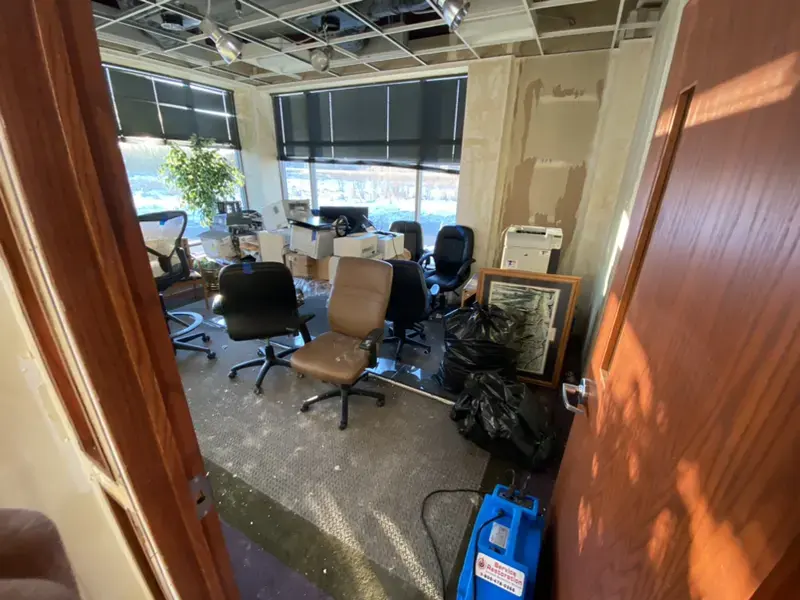
Commercial Water Damage in Santa Monica, CA
A water loss in a restaurant, office or shop costs money every hour the doors stay closed. The restoration team extracts, dries and documents around business hours where the loss allows it.
(888) 563-9619Water in a Santa Monica business? Call nowHow commercial water damage is handled in Santa Monica
Commercial water losses are planned as much as they are dried. The restoration team maps the loss, sets containment so unaffected areas can keep working, phases equipment around business hours and keeps a separate record for each space.
First steps for commercial water damage in Santa Monica
- 1
Stop the source
Close the sprinkler zone valve or the main, or call building maintenance.
- 2
Protect people and stock
Keep staff and customers away from wet floors and ceilings.
- 3
Move inventory up
Lift stock, paper and electronics off the floor where it is safe to do so.
- 4
Photograph for the claim
Record every affected space before cleanup starts.
What does commercial water damage cost in Santa Monica, CA?
In Santa Monica, CA, commercial water damage restoration typically runs $3,000 to $25,000 or more, depending on the square footage, the water category, the materials, how many tenant spaces were reached and whether drying has to be phased around business hours.
One suite or small shop
- Extraction and mapping
- After-hours drying
- Daily readings
Restaurant or multi-room
- Containment
- Kitchen cleanup and treatment
- Phased equipment
Large or multi-tenant
- Several spaces
- Desiccant drying
- Owner and tenant files
For a closer planning number, try the water damage cost calculator. The final price is set by the restoration company once it has seen the loss.
How commercial water damage is dried and documented
- 1
Map the moisture
Before a single fan is set, the tech who does the walkthrough scans floors, walls and ceilings with thermal imaging and pinless meters and draws the wet edge.
- 2
Pull the water
The extraction crew pulls standing water out through truck-mounted hoses or portable units, whichever reaches the unit, so it leaves the building.
- 3
Set the drying
The drying team places air movers and LGR dehumidifiers room by room, sized to the load and to how damp the coastal air is that week.
- 4
Read, log, verify
Every day the readings go into a log, and the equipment stays until each wet material matches its dry reference within 2 to 4 points.
Santa Monica's commercial property runs from restaurants and shops on Main Street and Montana Avenue to offices along Wilshire and Ocean Avenue, hotels near the pier and retail around the Third Street Promenade. Water losses there look different from a house: a sprinkler head knocked off in a storage room, a roof drain that backs up in a storm, a walk-in cooler line that fails overnight or a restroom that floods a tenant below.
Common commercial water losses
- Sprinkler system discharges and broken sprinkler heads
- Roof drains and flat roofs overwhelmed in winter storms
- Kitchen lines, ice machines and dish stations in restaurants
- Restroom overflows that reach tenants or retail below
- Water heater and boiler room failures in hotels and buildings
Sprinkler water starts clean but runs through old pipe, so it is often dark and may be handled as Category 2. Restroom and floor drain water is usually Category 3.
Planning the job around the business
The tech who does the walkthrough maps moisture across the affected spaces and sets the category and class of the loss. The restoration team then plans with the owner or property manager: which areas can stay open, where containment goes, where equipment runs overnight and where it can be moved during business hours. Restaurants also have health code concerns, so food areas touched by contaminated water are cleaned and treated before reopening.
Documentation for owners, tenants and carriers
Commercial claims often involve the building owner's policy, the tenant's policy and business interruption coverage. The restoration team keeps a moisture map, daily drying logs, timestamped photos taken before any demolition and a line-item scope for each space. The OSHA rules on workplace safety apply during cleanup, and the EPA page on moisture in commercial buildings explains why fast drying matters in larger spaces.
Multi-unit residential buildings are often handled as commercial jobs as well, because they involve an owner, a manager and many residents at once.
Where the team handles commercial water damage around Santa Monica
The restoration team covers all of Santa Monica, from North of Montana and Wilshire Montana to Ocean Park, Main Street and Sunset Park, plus Venice, Brentwood, Mar Vista and West Los Angeles.
ZIP codes 90401, 90402, 90403, 90404 and 90405.
See every area coveredCommercial Water Damage in Santa Monica: common questions
Can a business stay open during drying?
Often partly. Unaffected areas can stay open while containment separates the drying areas, and some equipment can run after hours. The category of water decides what is safe.
Is sprinkler water clean?
It starts clean but runs through old pipe, so it is often dark and may be handled as Category 2. Water that reached floor drains or restrooms is handled as Category 3.
What does a restaurant need after a water loss?
Food areas touched by contaminated water are cleaned and treated before reopening, and health code requirements apply. Drying is planned around the kitchen and service hours.
Who coordinates with tenants and the property manager?
The restoration team works with whoever controls the building, and keeps separate records for each tenant space so each party's claim has what it needs.
How long does commercial drying take?
It depends on the size, materials and category. A contained office often dries in three to five days, while concrete, large open areas and hardwood take longer.
Does business insurance cover water damage?
Commercial property and business interruption coverage vary widely by policy. Coverage depends on your policy, so it is worth checking with your own insurer or broker.
Water loss at a Santa Monica business? Call now.
Every hour of standing water adds to the cleanup and the downtime. The restoration team extracts, contains and plans drying around the business.