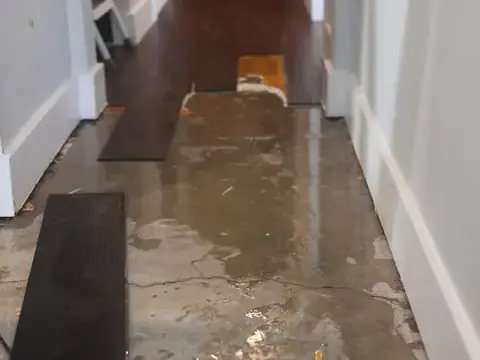
Slab Leak Water Damage in Santa Monica, CA
A pinhole in a line under a concrete slab can wet flooring for weeks before anyone notices. The restoration team maps the wet area, opens only what is needed and dries the slab and walls.
(888) 563-9619Warm spot or wet floor? Call Santa Monica dispatchHow slab leak water damage is handled in Santa Monica
A slab leak is invisible until the flooring gives it away, so the work is mostly measurement. The tech who does the walkthrough maps the wet area, the mitigation team lifts only the flooring over it, and the drying team dries the slab until the meters agree.
First steps for slab leak water damage in Santa Monica
- 1
Close the main
Shut the main valve so the broken line stops feeding water under the slab.
- 2
Note the warm spots
Mark any warm, swollen or damp areas so the tech can scan them first.
- 3
Watch the meter
Turn every fixture off and check whether the meter still moves.
- 4
Leave the flooring
Take photos but keep the floor down; it shows how far the water spread.
What does slab leak water damage cost in Santa Monica, CA?
In Santa Monica, CA, slab leak water damage restoration typically runs $1,500 to $7,500, depending on how long the leak ran, how many rooms or units the water reached, the flooring type and how much drywall has to come out. The plumbing repair is priced separately.
One room, caught early
- Moisture mapping
- Partial flooring lift
- Slab and wall drying
Water under several rooms
- Flooring removed where wet
- Baseboard and drywall cuts
- Daily readings
Long-running or next unit
- Adjoining unit checked
- Extended slab drying
- Full claim file
For a closer planning number, try the water damage cost calculator. The final price is set by the restoration company once it has seen the loss.
How slab leak water damage is dried
- 1
Map the moisture
Before a single fan is set, the tech who does the walkthrough scans floors, walls and ceilings with thermal imaging and pinless meters and draws the wet edge.
- 2
Pull the water
The extraction crew pulls standing water out through truck-mounted hoses or portable units, whichever reaches the unit, so it leaves the building.
- 3
Set the drying
The drying team places air movers and LGR dehumidifiers room by room, sized to the load and to how damp the coastal air is that week.
- 4
Read, log, verify
Every day the readings go into a log, and the equipment stays until each wet material matches its dry reference within 2 to 4 points.
South of Wilshire, and across the Pico Neighborhood and Sunset Park, a lot of Santa Monica was built after World War II on concrete slabs. So were most of the city's courtyard and dingbat apartment buildings. The water lines in those buildings run in or under the concrete, and decades of hard water and pressure changes thin the copper until a pinhole opens. Nothing drips from a ceiling. The water spreads sideways under flooring and wicks up the bottom of the walls, often for weeks.
How a hidden slab leak gives itself away
- One patch of floor feels warm underfoot, a sign of a hot line
- Plank or laminate starts to buckle, swell at the seams or feel spongy
- Carpet turns damp near a wall with no plumbing fixture close by
- The meter dial keeps turning while every tap is closed
- Baseboards swell along one run of wall
Finding the edge of the water
The line itself is a plumbing job, usually a reroute through the walls or attic instead of breaking up the slab. The water damage work is separate. The tech who does the walkthrough scans the floor and the base of every nearby wall with thermal imaging, confirms with pinless and pin meters, and marks where wet turns to dry. In a slab apartment building that mark sometimes lands in the next unit, on the other side of a shared wall.
Floating floors, vinyl plank and tile set in thinset trap water against the concrete, so the mitigation team lifts the floor covering over the wet zone and leaves the rest in place.
A slab that soaked for weeks holds water deep in the concrete. It is metered and signed off dry before any new flooring is laid over it.
Getting water out of concrete
With the leak fixed, air movers blow across the bare slab and along the base of the walls while LGR dehumidifiers pull the moisture out of the room. Close to the ocean the marine layer keeps humidity up, so the room is kept closed and the dehumidifiers do the heavy work. The drying log records the slab and wall readings every day until they reach the goal. The EPA WaterSense leak checks walk through reading your meter for a hidden leak, and the USGS water hardness page explains the minerals that wear on copper lines.
Where the team handles slab leak water damage around Santa Monica
The restoration team covers all of Santa Monica, from North of Montana and Wilshire Montana to Ocean Park, Main Street and Sunset Park, plus Venice, Brentwood, Mar Vista and West Los Angeles.
ZIP codes 90401, 90402, 90403, 90404 and 90405.
See every area coveredSlab Leak Water Damage in Santa Monica: common questions
What are the signs of a slab leak in Santa Monica?
A warm patch of floor, plank flooring that swells or buckles, damp carpet away from any fixture, swollen baseboards and a water meter that turns with every tap closed.
Does the plumber or the restoration team handle a slab leak?
Both, for different parts. The plumber repairs or reroutes the line. The restoration team maps the moisture, lifts wet flooring and dries the slab and walls.
Will every floor in the unit be torn up?
No. The moisture map marks the edge of the water, and only the flooring over the wet zone comes up.
How many days does a wet slab take to dry?
A small wet area often dries in three to five days once the leak is fixed. A slab that soaked for weeks can take longer, and the readings decide.
Can a slab leak spread to the apartment next door?
It can. In slab buildings water moves under shared walls, so the unit on the other side is metered before the job is closed out.
Is a slab leak covered by insurance?
Policies often treat the resulting water damage separately from the pipe repair, and long, slow leaks can be excluded. Coverage depends on your policy, so it is worth checking with your own insurer.
Water under the slab in Santa Monica? Call now.
The longer a slab leak runs, the more flooring and wall it takes with it. The restoration team maps it and dries it to the readings.