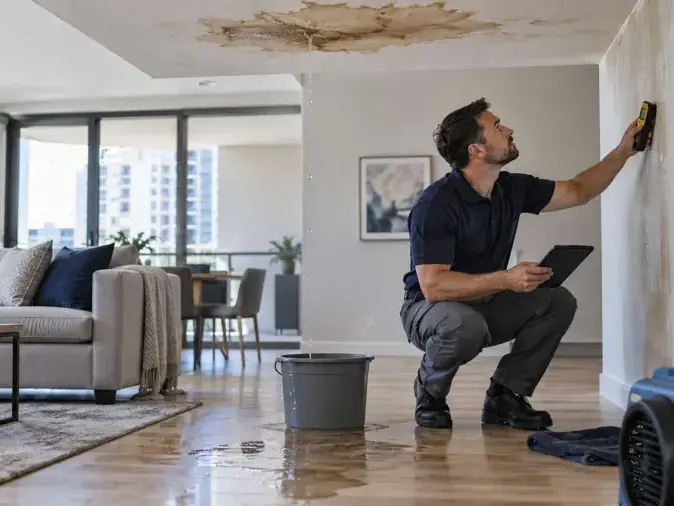
Condo and Apartment Leak Water Damage in Santa Monica, CA
Most Santa Monica households live in stacked units, so a washer hose or shower pan upstairs can end up in the ceiling downstairs. The restoration team traces the water across units and dries every one it reached.
(888) 563-9619Water coming from the unit above? Call nowHow condo and apartment leak water damage is handled in Santa Monica
Unit-to-unit leaks are traced from where the water shows back to where it started. The restoration team maps every affected unit and common area, dries each one to a dry reference and keeps a separate file for each owner, tenant and the HOA.
First steps for condo and apartment leak water damage in Santa Monica
- 1
Shut the fixture or unit valve
Close the valve upstairs if you can reach it, or ask the manager to shut the riser.
- 2
Tell the building
Notify the HOA, manager and the neighbor above or below right away.
- 3
Protect the ceiling area
Keep people out from under a sagging ceiling and switch off those lights.
- 4
Photograph both units
Take photos in every affected unit before anything is moved or removed.
What does condo and apartment leak water damage cost in Santa Monica, CA?
In Santa Monica, CA, condo and apartment leak water damage restoration typically runs $1,200 to $9,000, depending on how many units the water reached, whether ceilings or walls must be opened, the flooring in each unit and how fast drying started.
One unit, contained
- Source traced and mapped
- Drying in one unit
- Daily readings
Two or three units
- Ceilings opened where wet
- Equipment in each unit
- One file per unit
Stacked or multi-floor
- Several floors and a hallway
- Plaster or hardwood drying
- HOA documentation
For a closer planning number, try the water damage cost calculator. The final price is set by the restoration company once it has seen the loss.
How a unit-to-unit leak is dried in Santa Monica
- 1
Map the moisture
Before a single fan is set, the tech who does the walkthrough scans floors, walls and ceilings with thermal imaging and pinless meters and draws the wet edge.
- 2
Pull the water
The extraction crew pulls standing water out through truck-mounted hoses or portable units, whichever reaches the unit, so it leaves the building.
- 3
Set the drying
The drying team places air movers and LGR dehumidifiers room by room, sized to the load and to how damp the coastal air is that week.
- 4
Read, log, verify
Every day the readings go into a log, and the equipment stays until each wet material matches its dry reference within 2 to 4 points.
Santa Monica is a city of renters and condo owners, and a large share of homes sit in multi-unit buildings from the 1950s through the 1970s, stacked unit over unit with shared plumbing chases. When water escapes in one unit it follows framing, pipe penetrations and light fixtures into the next. A stain on a living room ceiling is often the first sign of a leak two floors up.
Where unit-to-unit leaks usually start
- Washing machine hoses in stacked laundry closets
- Toilet supply lines and wax ring seals
- Shower pans and tub drains in original tile bathrooms
- Dishwasher and refrigerator lines in galley kitchens
- Water heaters in interior closets
- Drain stacks and cast iron fittings inside shared walls
Tracing the water across units
The tech who does the walkthrough starts where the water shows and works up and sideways. Thermal imaging finds the cool, wet areas behind ceilings and walls, and pinless meters confirm them without opening anything. The goal is a moisture map for every affected unit and the common areas between them, so the drying plan covers all of the water, not just the unit that called.
A plumber or the building maintenance team repairs the leaking fixture. The restoration side covers extraction, removal of materials that cannot be dried, drying equipment in each unit and the daily readings that show when each unit is dry.
In a condo, the unit where the leak started and the unit that got wet may be covered by different policies. Documentation from every unit keeps the claim moving for everyone involved.
Owners, tenants, HOAs and managers
Condo losses often involve an HOA master policy for the building and individual unit policies for interiors and belongings. Apartment losses involve the owner or manager and, for belongings, a renter's policy. The restoration team keeps one file per unit with timestamped photos taken before any demolition, the moisture map and the drying log, which is what adjusters on each side ask for. The California Department of Insurance explains how homeowner, condo and renter policies differ, and the EPA WaterSense leak checks show how to find a slow fixture leak before it reaches a neighbor.
Drying without moving everyone out
Most unit-to-unit losses are dried with residents still living in the building. Equipment is placed to keep hallways and exits clear, and the drying team plans visits around the building's access rules. Ceilings with sagging drywall or plaster are taken down first, because a heavy wet ceiling can fall.
Where the team handles condo and apartment leak water damage around Santa Monica
The restoration team covers all of Santa Monica, from North of Montana and Wilshire Montana to Ocean Park, Main Street and Sunset Park, plus Venice, Brentwood, Mar Vista and West Los Angeles.
ZIP codes 90401, 90402, 90403, 90404 and 90405.
See every area coveredCondo and Apartment Leak Water Damage in Santa Monica: common questions
Who is responsible when water comes from the unit above?
It depends on the governing documents, the cause and the policies involved. Tell the building manager or HOA right away, and keep photos of the damage in your unit. The restoration file documents what happened in each unit.
Can drying happen while I stay in the unit?
Usually yes. Air movers and dehumidifiers run for several days and make noise, but most unit-to-unit losses are dried with residents at home unless sewage or a ceiling collapse is involved.
Why does the unit below need to be checked?
Water follows gravity through ceilings, pipe openings and light fixtures. A unit below can be wet inside the ceiling before any stain appears.
What does the HOA need from the restoration team?
Most boards and managers want the moisture map, daily readings for each unit, photos taken before demolition and a scope of the work. That file also supports each owner's claim.
How many days does a unit-to-unit leak take to dry?
A leak caught early in one or two units usually dries in three to five days. Ceilings, plaster and hardwood take longer, and the drying goal is set by readings, not a calendar.
Is condo leak damage covered by insurance?
Sudden leaks are commonly covered under a master or unit policy, while slow leaks over time are often excluded. Coverage depends on your policy, so it is worth checking with your own insurer.
Leak between units in a Santa Monica building? Call now.
Water in a stacked building keeps moving down. The restoration team traces it, maps each unit and dries the whole path.