Sewage Backup Cleanup in Santa Monica, CA
Sewage is Category 3 water the moment it backs up. The restoration team seals off the area, strips out what the sewage soaked, disinfects what stays and then dries the building.
(888) 563-9619Sewage coming up a drain? Call nowHow sewage backup cleanup is handled in Santa Monica
Sewage is Category 3 the moment it backs up, so the order never changes: contain, protect, remove what it touched, clean and treat, then dry. The response team works behind containment with HEPA air scrubbers and full protective gear.
First steps for sewage backup cleanup in Santa Monica
- 1
Stop using water
No flushing, showers or laundry, and tell the rest of the building.
- 2
Keep everyone out
Close off the area and keep children and pets away.
- 3
Do not touch it
Avoid contact, and do not run fans that blow air across the sewage.
- 4
Photograph from a distance
Record the backup and the affected rooms, then call.
What does sewage backup cleanup cost in Santa Monica, CA?
In Santa Monica, CA, sewage backup cleanup typically runs $2,000 to $12,000, depending on the area affected, how much porous material must be removed, whether it is a single home or a shared building stack and how much drying follows. Clearing the sewer line is priced separately.
One bathroom or small area
- Containment and PPE
- Porous removal
- Antimicrobial treatment
Several rooms
- Drywall above wicking line
- HEPA air scrubbers
- Structural drying
Building stack or large loss
- Multiple units contained
- Hallway cleanup
- One file per unit
For a closer planning number, try the water damage cost calculator. The final price is set by the restoration company once it has seen the loss.
How a sewage backup is cleaned up and dried
- 1
Map the moisture
Before a single fan is set, the tech who does the walkthrough scans floors, walls and ceilings with thermal imaging and pinless meters and draws the wet edge.
- 2
Pull the water
The extraction crew pulls standing water out through truck-mounted hoses or portable units, whichever reaches the unit, so it leaves the building.
- 3
Set the drying
The drying team places air movers and LGR dehumidifiers room by room, sized to the load and to how damp the coastal air is that week.
- 4
Read, log, verify
Every day the readings go into a log, and the equipment stays until each wet material matches its dry reference within 2 to 4 points.
Sewer backups in Santa Monica usually come from two places. In older single-family homes, clay sewer laterals run under mature street trees, and roots work into the joints until the line blocks and sewage comes up through the lowest drain. In apartment buildings, cast iron drain stacks shared by every unit corrode and scale up inside, and a blockage low in the stack pushes wastewater out of a ground-floor tub or toilet.
Why a sewage backup changes the whole job
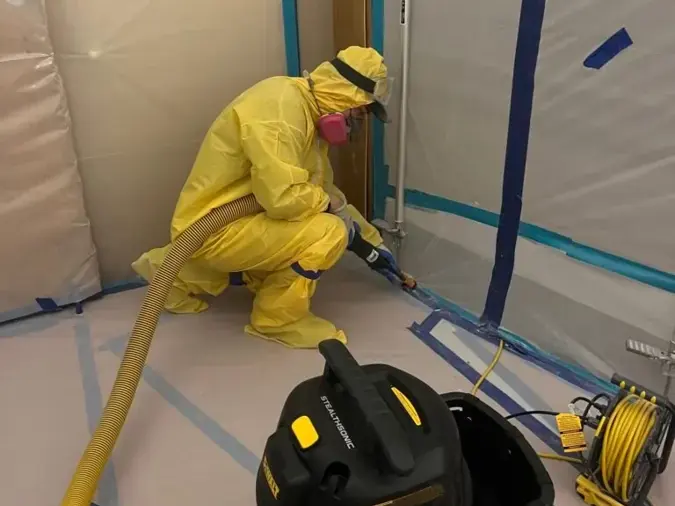
Wastewater carries bacteria, viruses and parasites. Under the IICRC standard it is Category 3 from the start, no matter how clean it looks. That changes the whole job: the area is contained with plastic sheeting, HEPA air scrubbers run to keep the air clean, and the crew wears protective suits, gloves, boots and respirators.
- Porous materials the sewage touched, such as carpet, pad, drywall and insulation, are removed and bagged
- Drywall is cut above the highest wicking line
- Nonporous surfaces are scrubbed, then an EPA-registered antimicrobial is applied and left for its full dwell time
- Drying starts only after cleaning is complete
Stop using water in the building when sewage backs up. Every flush and shower adds more wastewater to the backup, including from units upstairs.
Apartment buildings and shared stacks
When a shared stack backs up, the ground-floor unit takes the sewage while the units above keep sending water down. The building manager has to tell every resident to stop using water until a plumber clears the line. The restoration team contains the affected unit and any common hallway, and keeps a separate file for each unit that was reached.
Drying and verifying after the cleanup
Once contaminated materials are out and surfaces are treated, air movers and LGR dehumidifiers dry the framing and subfloor to the drying goal, with readings logged daily. The Centers for Disease Control and Prevention explains the health risks of wastewater, and OSHA sets the protective equipment rules for work around it.
Where the team handles sewage backup cleanup around Santa Monica
The restoration team covers all of Santa Monica, from North of Montana and Wilshire Montana to Ocean Park, Main Street and Sunset Park, plus Venice, Brentwood, Mar Vista and West Los Angeles.
ZIP codes 90401, 90402, 90403, 90404 and 90405.
See every area coveredSewage Backup Cleanup in Santa Monica: common questions
Is it safe to clean up a small sewage backup myself?
Sewage carries bacteria and viruses, and porous materials it touched cannot be cleaned safely at home. Keep people and pets away and call for Category 3 cleanup.
What causes sewer backups in Santa Monica?
Tree roots in older clay sewer laterals and corroded or scaled cast iron stacks in apartment buildings are the most common causes. Grease and wipes add to the blockage.
Can carpet be kept after a sewage backup?
No. Carpet and pad that sewage touched are bagged and removed. Hard flooring and framing are cleaned, treated with antimicrobial and dried.
What should residents upstairs do?
Stop running water, flushing and showering until a plumber clears the line. Water from upper units keeps feeding a backup in a shared stack.
How long does sewage cleanup take?
Containment, removal and cleaning usually take a day or two, and drying takes several more days depending on the materials. Readings decide when drying is done.
Is sewage backup covered by insurance?
Many homeowner policies need a separate sewer or water backup endorsement. Coverage depends on your policy, so it is worth checking with your own insurer.
Sewer backup in a Santa Monica home or building? Call now.
Sewage spreads contamination into everything porous it touches. The restoration team contains it, removes it and cleans what stays.