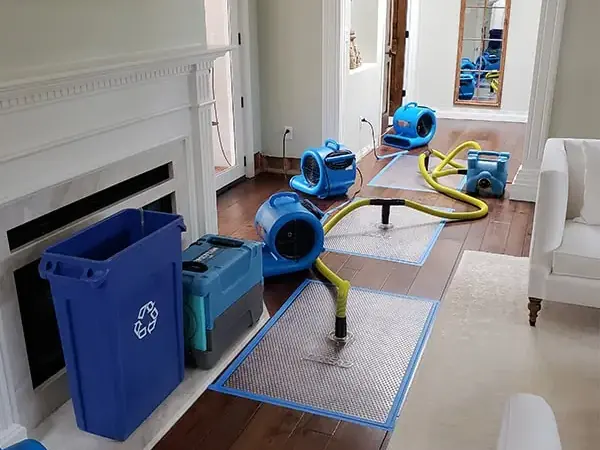
Structural Drying in Santa Monica, CA
A room can look dry days before the framing is. The drying team sizes equipment to each room, logs readings every day and pulls equipment only when the structure meets the drying goal.
(888) 563-9619Walls still wet after the water is gone? CallHow structural drying is handled in Santa Monica
The drying team treats drying as a measurement, not a waiting game. Each room gets equipment sized to its class of loss, readings are taken every day, and equipment comes out when the wet materials match a dry reference in the same building.
First steps for structural drying in Santa Monica
- 1
Leave equipment running
Keep air movers and dehumidifiers on, even overnight.
- 2
Keep the room closed
Close windows and doors to the drying area in damp coastal weather.
- 3
Keep walkways clear
Do not move equipment or cover it; it is placed for airflow.
- 4
Note any changes
Tell the drying team about new stains, smells or swelling.
What does structural drying cost in Santa Monica, CA?
In Santa Monica, CA, structural drying typically runs $1,000 to $8,000, depending on the class of the loss, how many rooms are drying, the materials involved (plaster, hardwood and concrete take longest) and how many days the equipment runs.
Class 1 or 2, one area
- Air movers and LGR
- Daily readings
- Drying log
Several rooms or cavities
- Wall cavity drying
- Psychrometric monitoring
- Moisture map updates
Class 4 materials
- Desiccant dehumidification
- Hardwood or plaster
- Extended monitoring
For a closer planning number, try the water damage cost calculator. The final price is set by the restoration company once it has seen the loss.
How structural drying is run and verified
- 1
Map the moisture
Before a single fan is set, the tech who does the walkthrough scans floors, walls and ceilings with thermal imaging and pinless meters and draws the wet edge.
- 2
Pull the water
The extraction crew pulls standing water out through truck-mounted hoses or portable units, whichever reaches the unit, so it leaves the building.
- 3
Set the drying
The drying team places air movers and LGR dehumidifiers room by room, sized to the load and to how damp the coastal air is that week.
- 4
Read, log, verify
Every day the readings go into a log, and the equipment stays until each wet material matches its dry reference within 2 to 4 points.
Structural drying is the part of a water loss nobody sees and everyone pays for if it is skipped. Surface drying makes a room look normal. Structural drying gets the water out of the framing, subfloor, wall cavities and plaster, where it would otherwise stay long enough to swell wood, loosen finishes and grow mold.
How the drying is sized
The IICRC S500 standard sorts every loss by category, meaning how clean the water was, and by class, meaning how much water there is and how hard the materials are to dry. Class 1 is a small area of low-porosity material. Class 4 covers dense materials such as hardwood, plaster and concrete that hold water deep inside. That class decides the number of air movers and the amount of dehumidification per room.
- Air movers push dry air across wet surfaces to speed evaporation
- LGR dehumidifiers pull that moisture back out of the room air
- Desiccant dehumidifiers handle Class 4 materials and cool, damp spaces
- Wall cavity and floor drying systems reach water behind surfaces
Near the coast, opening windows rarely helps. The marine layer keeps outdoor air humid, so the drying team closes the room and controls the air with dehumidifiers instead.
Why coastal air changes the plan
Santa Monica's marine layer, strongest in late spring and early summer, keeps humidity high near the ocean for much of the year. Evaporation slows when the air is already damp, so the drying team leans on dehumidification and keeps the drying area closed. Psychrometric readings, meaning temperature and humidity inside and outside the drying area, are taken daily to confirm the equipment is actually removing water.
The drying goal and the log
Every wet material is compared with a dry reference, a similar material in an unaffected part of the building. Equipment comes out when wet materials read within 2 to 4 points of that reference, not on a fixed day. The daily log, the moisture map and photos go into the file for your insurer. The EPA moisture page explains why structural moisture matters, and the National Weather Service Los Angeles office tracks the marine layer and coastal humidity.
Where the team handles structural drying around Santa Monica
The restoration team covers all of Santa Monica, from North of Montana and Wilshire Montana to Ocean Park, Main Street and Sunset Park, plus Venice, Brentwood, Mar Vista and West Los Angeles.
ZIP codes 90401, 90402, 90403, 90404 and 90405.
See every area coveredStructural Drying in Santa Monica: common questions
What is the difference between surface and structural drying?
Surface drying makes a room look dry. Structural drying removes water from framing, subfloor, cavities and plaster, and it is verified with meters, not by touch.
How long does structural drying take?
A small Class 1 loss in one room is typically dry in three to five days. Hardwood, plaster and concrete take longer. Equipment stays until the readings meet the goal.
Why not just open the windows?
In Santa Monica the outdoor air is often humid because of the marine layer. Opening windows can slow drying, so the area is closed and dehumidified instead.
What is a dry reference?
It is a reading from the same kind of material in a part of the building the water did not reach. A wet material counts as dry once it reads within 2 to 4 points of that reference.
Are the drying machines noisy?
Yes, air movers and dehumidifiers run around the clock and make steady noise. They are placed to keep walkways clear and are usually needed for several days.
Does insurance cover structural drying?
Drying after a sudden, covered water loss is commonly part of the claim, and the daily log supports it. Coverage depends on your policy, so it is worth checking with your own insurer.
Need a Santa Monica structure dried properly? Call now.
Drying that stops at the surface leaves water in the framing. The drying team meters it until the structure is actually dry.